
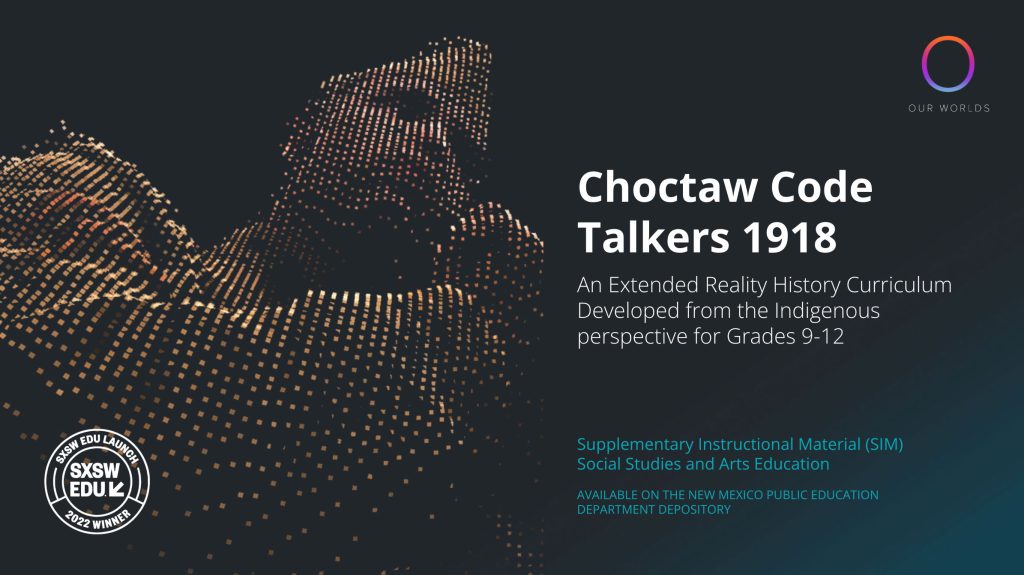
Choctaw Code Talkers 1918
Discover the story of the Choctaw Code Talkers—Native American soldiers who used their language to help secure Allied victory in World War I. This curriculum situates their contributions within the broader history of the Great Wars, offering an accessible entry point for high school classrooms. Developed in collaboration with the Choctaw Nation of Oklahoma’s Historic Preservation Department and descendants of the original Code Talkers, the experience centers primary voices, cultural context, and historical accuracy.
EST DURATION
4 hrs
GRADE LEVEL
9th – 12th grade
PUBLISHED
March 1, 2026
Curriculum Guide For Teachers
Refer to this page as the instructor guide as you conduct your lessons. This page mirrors the full Google Classroom version of the Choctaw Code Talkers curriculum. Lessons are organized into Units 1–3 (1.1–3.5) in expandable sections for easy navigation. Each lesson includes project titles, step-by-step instructions, and direct links to readings, primary sources, VR experiences, and AR activities. It is up to you whether to use the Google Classroom or Google Drive buttons – please choose to suit your methods. Whether previewing content, sharing to your Google Classroom or teaching from another platform, this format provides a complete, accessible view of the learning sequence.
Curriculum Guide for Students: Students may refer to these same lesson elements in their workbooks and keep all their work for this unit in one place. To share a unique workbook to each student via Google Classroom, please visit the “Share Workbooks” link below and select the following options in the Google Classroom sequence: 1) Share to class; 2) Share action –> Create assignment; 3) File sharing options –> Make a copy for each student.
Lesson 1: Introduction to WWI
Pre-Survey: What Do You Know About WWI?
Before we begin, take a moment to write what you already know about World War I. Use your own words—don’t look anything up. This helps us see what you already understand before learning something new.
Post-Survey: What Do You Still Want to Know?
Now that you’ve watched the experience, what are you most curious to learn more about—either in the story of the Choctaw Code Talkers or about World War I in general?
Read, Think, Pair & Share: Choctaw Code Talkers
Choose one of the readings below for your class. Then, pair with another student to write a response to one of the following 2 questions:
- Why do you think it was important to transmit coded messages during WWI?
- What images come to mind when you hear the phrase “telephone warrior?
Watch: KXII News Story + 3-2-1 Exercise
Watch the video below about the commemoration of the code talkers in Choctaw Nation:
Discuss with your partner, or with your class, then write the answers in the provided document:
- 1) Name 3 things you learned from the news story video
- 2) Name 2 questions you still have after watching the news story
- 3) Name 1 interesting thing about the story of the Code Talkers from either the VR experience or the news story.
Lesson 2: WWI, On the Frontlines
Watch: Technology During WWI
As you watch, jot down anything that surprises you about what you learn in this video in the attached workbook doc.
Microlab Reading: The Effect of Technology on WWI
Today you’ll explore how new technologies changed the experience of World War I—through both reading and real historical photographs.
Working in , assign each person a role:
- Reads the passage aloud to the group.
- Marks key ideas, inventions, and turning points in the text.
- Takes notes on the and writes down group insights.
As you read, pause often to discuss what each new technology—like trench systems, gas masks, field phones, or tanks—reveals about innovation, survival, and the human cost of war.
Then, open the from the Library of Congress, featuring historic NYTimes images and captions from the period. Look carefully at each photo and headline: what details show how new technologies shaped the battlefield and soldiers’ lives?
These photographs are original evidence from people who lived through World War I. Studying them helps historians (and you) understand not just what happened, but how people about those events at the time. The Library of Congress is one of the best places to explore these sources—its collections are free and open to everyone.
After your group finishes the reading, worksheet, and photo analysis, complete the short reflection below on your own:
- Which invention or tool do you think had the greatest impact on soldiers’ daily lives—and why?
- Think about both its practical use and its emotional or human effect.
Visit: Hear Choctaw Code Talkers
Step inside a 360° virtual memorial at the Choctaw Code Talkers Memorial in Tuskahoma, Oklahoma. Hear Choctaw code spoken by the soldiers during WWI, as documented by military records of the 142nd Infantry Regiment, blended with recreations of spoken code that could have been used based on regiment’s recorded military strategies at the time. As you go through the video, jot down your thoughts in the Curriculum Deck.
This project was created with the Choctaw Historical Projects Department and the School of Choctaw Language – read by Mike Davis, a Choctaw elder who grew up speaking the language.
Watch: Visualizing the Great War
Below, you will find two data visualizations:
- a map showing how troop lines moved and shifted over time.
- each falling poppy represents one life lost in World War I.
As you watch, think not only about what is being but how it makes you and the scale and human cost of war.
Write a addressing the prompts below.
- What patterns or changes do you notice in each visualization?
- How does the visual format (falling poppies, moving lines) help you understand something that numbers alone cannot?
- What emotions or thoughts arise as you watch the data unfold?
- How might these visualizations shape the way people remember or forget the war?
- If you were designing your own visualization of this history, what would you include or change?
Scan and Learn: WWI Tools & Artifacts in Augmented Reality
Step into history using augmented reality! In this interactive activity, you’ll explore 12 authentic World War I artifacts—like a field phone, gas mask, camera, and even a life-size soldier—projected right into your classroom. Tap each object to reveal stories of technology, survival, and communication on the front lines. As you move through the AR experience, notice how the scale, materials, and design of each item reveal what life was like for soldiers a century ago. Afterwards, reflect on which artifact spoke to you most—what story does it tell about human ingenuity and resilience during the war?
Lesson 3: Post-WWI, Recognition & Aftermath
Watch: National Native American Memorial Museum
Artist and veteran Harvey Pratt shares the story behind his memorial sculpture at the National Native American Veterans Memorial—honoring Indigenous warriors, their families, and the enduring spirit of service and sacrifice.
- What symbols or design elements stood out to you in Pratt’s memorial?
- How does his dual identity as artist and veteran shape the meaning of his work?
- What emotions or ideas does the memorial invite visitors to feel or remember?
- Why is it important that Native veterans are honored in a space created by one of their own?
- How do art and remembrance connect in this memorial?
Create: Memorials & Legacy-Making
In this activity, you’ll read about individual soldiers from The First Code Talkers by William Meadows and related articles from the Choctaw Nation. As you learn each soldier’s story, consider how their language, courage, and service helped shape both military history and cultural survival. Using your notes and the biography tracker, you’ll then design a visual tribute that honors one Code Talker’s legacy—using Canva, Piktochart, or the OurWorlds app. Your goal is to capture not just what they did, but and how their story continues to speak today.
Virtual Field Trips
Using your phone, tablet, or computer, visit sites using the links below and step into history through a series of 360° videos featuring three World War I memorial sites in France and the United States. As you explore each space, pay attention to what you notice, feel, and wonder—how do design, sound, and setting shape the way we remember? Use the to record your thoughts, reactions, and questions while you move through the experience. Your notes will guide our upcoming class discussion on how memorials keep stories—and emotions—alive.
Choctaw and Indian Country Today
To round out your understanding of Native American governance and culture today, watch the first film in the list below, “Native American Reservations, Explained”. Then, in your group of 3, each of you will choose a different video from the list below to watch and discuss what you’ve learned together. Use the Padlet below to collect your ideas and make connections, to synthesize your understanding of contemporary Choctaw culture and what you have learned about Choctaw history through the Code Talker story.
Final Survey
Thank you for participating in this program. Here are a few questions to help us gauge its effectiveness.
Extension: Cumulative Curriculum Project
Activity: Create a Podcast!
If you could hear from a Choctaw Code Talker today, what do you think he would say?
For this assignment, your goal is to work with a classmate to create a 7-10 minute imaginary podcast of an interviewer talking to one of the Code Talkers.
To accomplish this, look through the provided materials, decide which of the soldiers you would like to highlight, then research his life and the context of the time, and write a script of questions and answers together with your partner. Rehearse the script a few times, then record it on audio and submit it here.
Please see the resources below for reference material. You will have a few days to prepare this – please reach out for help if you need guidance before your presentation!
Activity: Podcast Presentations
Today, we’ll listen to each group’s podcast , where you stepped into the voice of a Choctaw soldier to share his story and perspective. As you listen to your classmates’ episodes, focus on their presentation themes, and how these connect across stories. Notice how each interpretation brings out different aspects of language, identity, and service.
Use page 18 from your student workbook to jot down:
- One phrase or idea that stood out
- Something you learned from another group’s portrayal
- A connection you can make between the Code Talker stories and modern Choctaw culture
After all presentations, we’ll discuss together:
- How does hearing these voices—your own and your classmates’—change the way you understand history?